Work/ MAST Safety
Rebrand, content & SEO · Health, safety and HR consultancy
A rebrand that became a repositioning
New owners took on RB Health & Safety and asked us for a fresh identity and a website to match. We rebranded it as MAST Safety. What neither of us knew then was that the business was about to change shape, and that most of the work would be keeping the website honest about what it had become.
- Sector
- Health, safety & HR
- Project
- Rebrand, then rebuild
- Also
- SEO, email campaigns & Microsoft 365
This client is based in Canary Wharf, London
The starting point
A new owner, and a brand ready for a reset
RB Health & Safety had been taken on by new owners with bigger plans. They wanted to move on from the old name, present a growing range of services properly, and make it far easier for customers to find the right course. They handed us an outline of the services and the freedom to shape the rest, the name included.
The business that launched as MAST Safety was a version of the one that had been bought. Some consultancy, and a hard focus on training. That was the right shape for the time, and the first site was built to suit it.
What changed
Training got smaller, consultancy got bigger
Over the following years the balance moved. Training became a smaller part of what MAST did, while more time and energy went into the consultancy side: competent person cover, audits and inspections, risk assessments, RAMS and policy work, CDM and principal designer support, accident and HSE support, and help with accreditations like CHAS and SafeContractor.
A website does not follow a business anywhere on its own. Each time the services grew, the site had to grow with them, in the page copy and in the search work behind it, so that somebody looking for the newest thing MAST did could actually find it.
We also write their weekly email campaigns and their news articles, tracked against the work the team is doing and the latest advice out of the HSE. That is the part that keeps a professional services site from going quiet between projects, and it is why the search work has something recent to hold on to.
The move
Canary Wharf, and a site to match it
The decision to take a London office at Canary Wharf was about reach. A central base makes the growing client base across the South East far easier to serve, and it makes getting to a client's premises a straightforward thing rather than a day out.
It was also the moment to stop extending the old site. The services now run well past health and safety into HR, and they are delivered to offices, education and care, hospitality, retail, manufacturing, warehousing and property as much as to construction. None of that was what the original site had been built to say.
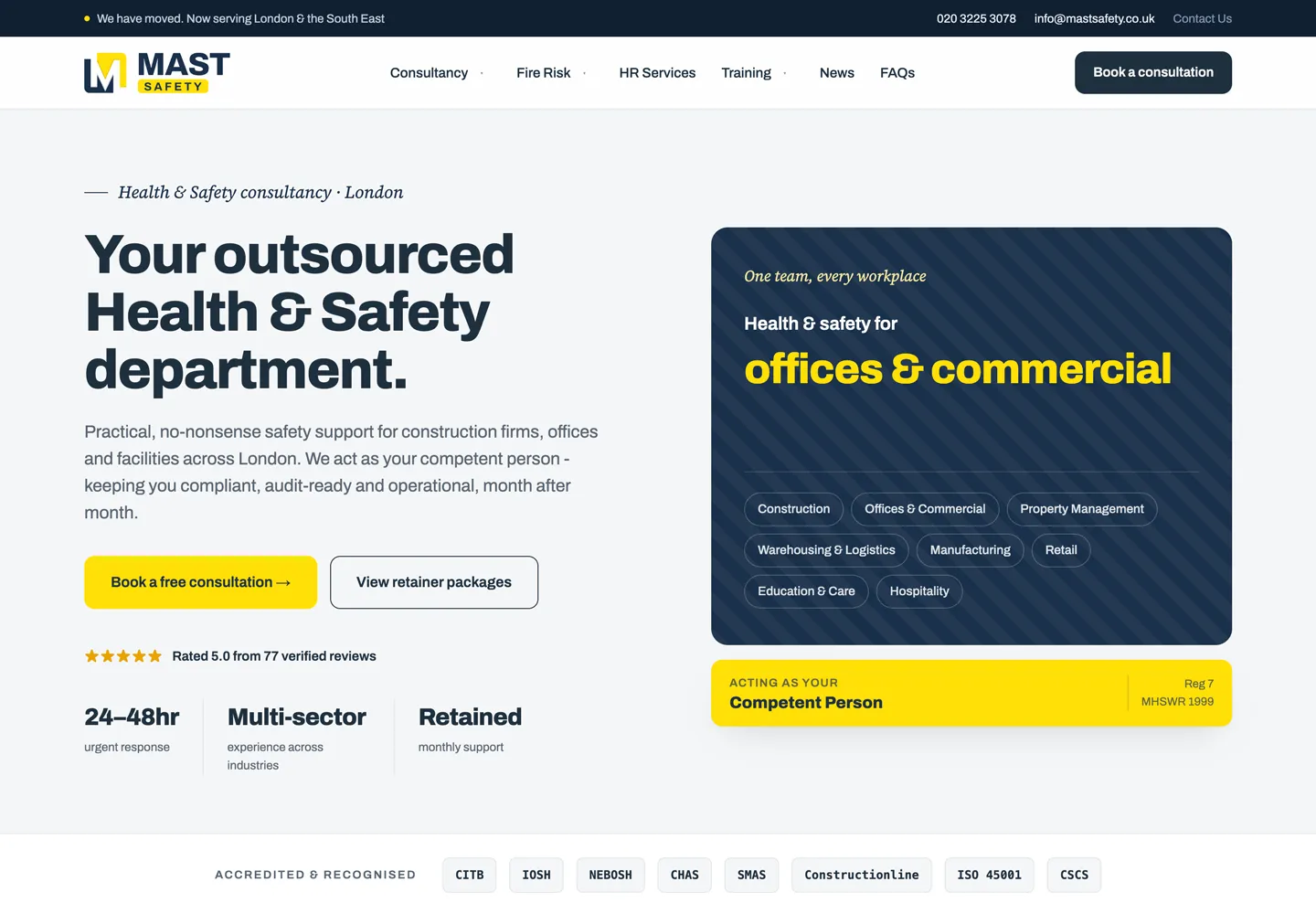
So the new site is organised around what MAST actually does now: consultancy, fire risk, HR services and training, with the sectors named rather than implied, and retainer tiers for clients who want ongoing cover rather than a job at a time.
The training pages
Training without a timetable
Most training pages are a calendar. Here are our dates, here are our prices, pick one. It is a tidy way to present a course and it quietly hands the work to the buyer, who now has to find a date they can make, somewhere they can reach, for the exact certificate they need.
MAST's course pages carry no schedule. You say which course you are after, roughly when you are free and where you are, and somebody comes back the same working day with what fits. Where a client has enough people to fill a session, the training goes to their premises instead.
It reads as less on the page and it is more in practice. Somebody in Kent has little use for a date in Canary Wharf, and a company with eight people to certify would rather not send them all across London for the day. Sorting that out properly takes a conversation, so the page is built to start one rather than to display a timetable.
The service pages
Why they carry no photographs
There is a photograph on almost every health and safety website in the country: a worker in a hard hat on a building site. It is a perfectly good photograph, and on a page about construction audits it does its job well.
The difficulty is that MAST does that same audit for a care home, a bar, an office and a theatre. Somebody running a residential home who lands on a page fronted by scaffolding sees an industry that is not theirs, and quietly decides the service is not for them either. The picture has told them something untrue before a word of the copy has been read.
So the service pages carry no stock imagery. An image can only ever show one of the settings a service applies to, and picking one means excluding the others. The words can describe all of them, so on these pages the words are what does the work.
What sits there instead is the sector itself. The homepage names the kind of workplace MAST looks after and cycles through them, construction sites, offices, education and care, hospitality, manufacturing, retail, warehousing, so a visitor sees their own industry named rather than somebody else's pictured.
What we look after
A rebrand, and everything since
A brand-new identity
A complete new look and feel, repositioning the business as MAST Safety, name, logo and visual identity included.
Two websites, years apart
The first built for a training-led business, the second for the consultancy it became, with the Canary Wharf move as the moment to start again.
Content that kept pace
Page copy written and rewritten as the services grew, so the site never described a smaller business than the one behind it.
Search work alongside it
SEO carried out in step with the content rather than after it, so each new service could be found by the people looking for that particular thing.
Weekly email campaigns
Written each week around the work the team is doing and the latest guidance from the HSE, rather than assembled from a template.
Email and Microsoft 365
The mailboxes and the day to day email platform behind the business, looked after alongside the site.
Let's talk
Has your business outgrown its website?
It rarely happens all at once. Services get added, the balance shifts, and one day the site is describing a smaller version of what you do. We would be glad to take a look and tell you whether it needs extending or replacing.
Start a conversation%20--%3e%3crect%20x='356'%20y='418'%20width='88'%20height='8'%20rx='4'%20fill='%23eb5648'/%3e%3crect%20x='300'%20y='436'%20width='200'%20height='12'%20rx='4'%20fill='%233a3a3a'/%3e%3crect%20x='46'%20y='474'%20width='222'%20height='150'%20rx='12'%20fill='%23ffffff'%20stroke='%23ebebeb'/%3e%3crect%20x='62'%20y='490'%20width='190'%20height='86'%20rx='8'%20fill='%23eaeaea'/%3e%3crect%20x='289'%20y='474'%20width='222'%20height='150'%20rx='12'%20fill='%23ffffff'%20stroke='%23ebebeb'/%3e%3crect%20x='305'%20y='490'%20width='190'%20height='86'%20rx='8'%20fill='%23eaeaea'/%3e%3crect%20x='532'%20y='474'%20width='222'%20height='150'%20rx='12'%20fill='%23ffffff'%20stroke='%23ebebeb'/%3e%3crect%20x='548'%20y='490'%20width='190'%20height='86'%20rx='8'%20fill='%23eaeaea'/%3e%3c/svg%3e)